Ownership Isn't the Problem. Unclear Expectations Are.
Jul 31, 2026
There's a moment almost every food leadership team has lived through. Someone drops the ball. A leader says, half exhausted, half frustrated: "I just need my people to own their work." It feels true in the moment. It's usually not the real issue.
Ownership doesn't fail because people don't want it. It fails because most companies never actually defined what belongs to whom in the first place. You can't own something nobody clearly handed you.
Think about how most roles actually get built in food companies. A position opens up. Someone writes a job description fast, usually borrowed from the last person who held it, tweaked slightly, and posted. Responsibilities get divided informally in the day-to-day chaos of production schedules and audit prep, not in a deliberate conversation about who owns what and why. Six months in, three different people think they're responsible for the same thing, and two things nobody's responsible for at all.
That's not a people problem. That's a clarity problem, and it's expensive.
Gallup's 2024 research on workplace disengagement found that improving clarity of expectations from where most companies sit today to best-practice levels is linked to a 9% increase in profitability and an 11% improvement in work quality. Not effort. Not attitude. Clarity. Knowing what you're actually responsible for, and what you're not, is one of the most underpriced levers in a leadership team's hands.
Source: Wigert, B., & Tatel, C. (2024, December 3). The Great Detachment: Why Employees Feel Stuck. Gallup.
Where This Shows Up First in Food Leadership
Nowhere does unclear ownership show up faster than in Food Safety & Quality (yeah, we’re a little biased!). When a compliance gap appears, a document's missing, a line's behind schedule, someone from FSQ almost always steps in to cover it, even when it isn't theirs. And here's the part worth sitting with: that instinct isn't the problem. Stepping up once in a while, covering a gap because someone's out sick or slammed, that's teamwork. That's what good teams do for each other.
But when it happens constantly, when the same person is quietly absorbing work that was never assigned to them, that's not teamwork anymore. That's a clarity failure wearing a teamwork costume. And it's exhausting in a specific way, because the person picking up the slack usually feels like they're doing the right thing. They're being the reliable one. What's actually happening is the company never built a system where responsibility was clear enough that this kind of quiet over-functioning wasn't necessary in the first place.
The Fix Isn't Better Boundaries. It's Better Definition.
This is where a lot of leadership advice gets it backwards. The instinct is to tell the person doing the absorbing to set better boundaries, stop picking up everything, learn to say no. That's not nothing, but it treats the symptom. The real fix is upstream: does everyone on this team actually know, in specific terms, what's theirs to own? Not their job title. Not a bullet point on a job description written two years ago. The actual, current, real answer to "if this breaks, whose job is it to notice and fix it."
If you can't answer that clearly for every role on your team, your people can't either. And they'll keep doing what capable, conscientious people always do when the lines are blurry: they'll cover the gap themselves, quietly resent it a little more each time, and you'll keep wondering why "ownership" feels so hard to build.
It's not hard to build. It's hard to define. Those are different problems, and only one of them gets solved by asking people to try harder.
The Leader You'll Be Before 2027
Defining ownership clearly, for yourself and for the people you lead, is exactly what we build inside Bootcamp and Strategic Leader. Both cohorts start September 15th.
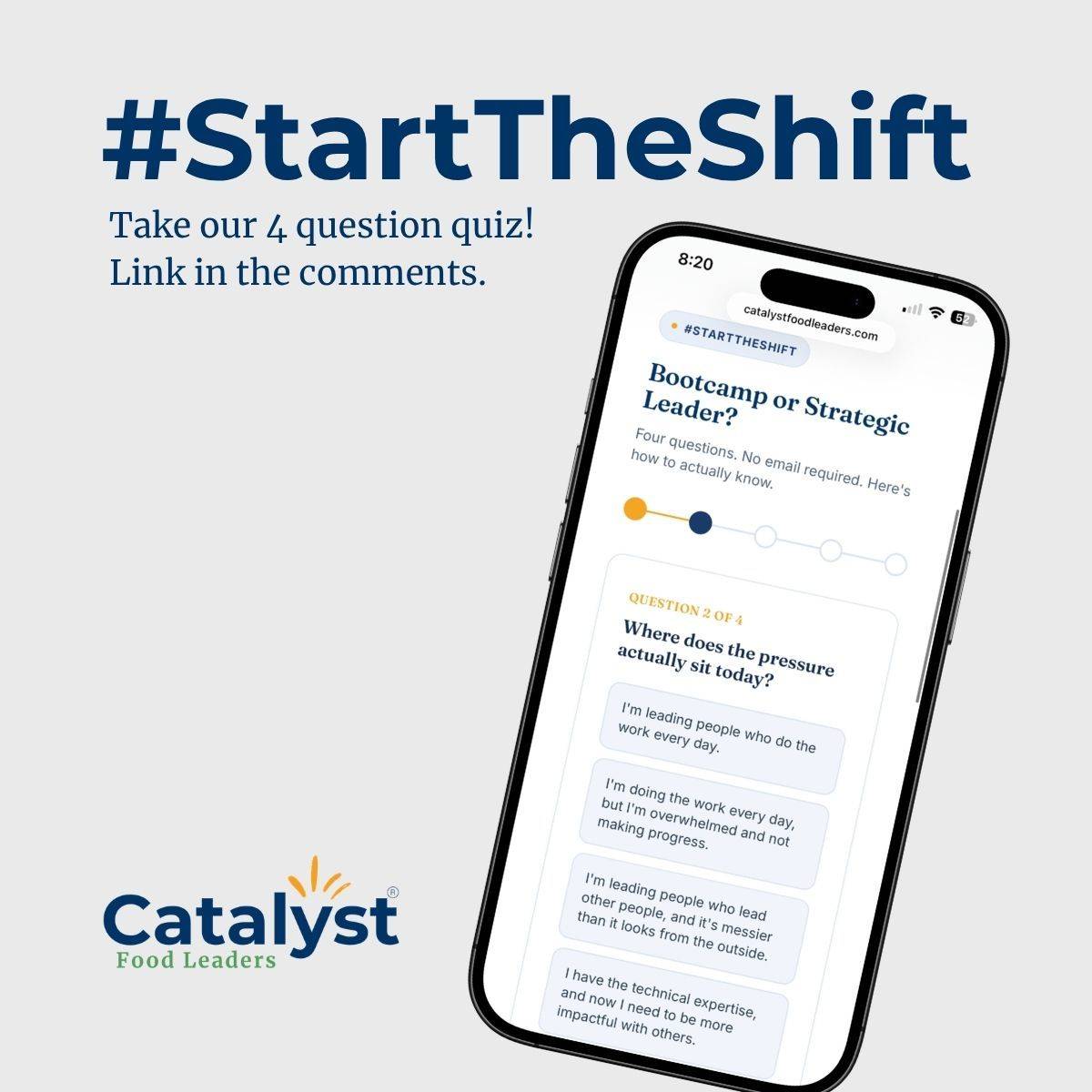
Not sure which one fits you or someone on your team? Take our four-question quiz, no email required, and find out in under a minute.
Take the Quiz: Bootcamp or Strategic Leader?
#StartTheShift