Food Industry Leadership Development for Better Teams
May 29, 2026
Here is something most food companies already know but rarely say out loud.
The biggest challenges on your floor are not technical ones. Your people know the procedures. They have been through the training. The SOPs are documented. The right boxes are checked.
What is harder to see is the gap between what is written and how things actually operate under pressure. That gap almost never lives in a procedure. It lives in how leaders lead.
Culture does not change unless leaders do. And leaders do not change unless someone actually invests in how they lead, not just what they know. That is what Food Industry Leadership Development is designed to do, and it is the work Catalyst Food Leaders was built for.
Bridging the Gap in Food Manufacturing
Every food company carries a version of the same frustration. Engagement scores that barely move. Turnover that will not stop. Initiatives that launch with momentum and plateau three months in. Leaders who know exactly what to say in a meeting and are far less certain what to do when no one is watching.
The instinct is to run another survey, schedule another training, rewrite another procedure. These things have their place. But they do not address the root cause. They measure how people feel. They do not change how leaders lead.
Catalyst was co-founded by Jill Stuber and Tia Glave, two professionals who built their careers inside the food industry before they built Catalyst. They have lived the pressure of third-party audits, production pushes, and the cost of losing a strong leader at the wrong moment. They did not have to be taught what this industry demands. They know it from the inside.
That is why the approach lands differently. Food Manufacturing Leadership Training built by people who have actually done this work reads and feels different to the leaders going through it. The specificity is not cosmetic. It is the whole point.
Leadership development is a business strategy. Not a perk. Not a feel-good initiative. A strategy with measurable outcomes in retention, accountability, audit readiness, and culture. Treating it as anything less is what keeps the gap open.
Building Leaders at Every Level
Organizations need a system that builds leadership capability from the ground up, one that compounds over time rather than starting from scratch every time someone earns a promotion.
Catalyst's progressive model does exactly that. Whether you are guiding a frontline supervisor through their first 90 days in a people manager role or developing a director-level leader who needs to shape culture across departments, there is a clear path forward. Development does not just repeat itself. It builds.
For individuals and teams, coaching-based programs are built specifically for the food industry. From Frontline Leader and Leadership Bootcamp to Strategic Leader cohorts, participants develop real skills they can apply immediately in the real conditions of their work. You can explore our leadership development options to see how we help leaders gain the clarity and confidence their roles demand.
For organizations, Catalyst focuses on building the culture your company is actually capable of, not just the culture described in your values statement. Enterprise work includes The Diagnosis, on-site consulting, and a comprehensive Leadership Transformation Program designed to make great leadership the norm across every function. Learn more about our leadership culture transformation services and what sustained engagement actually looks like.
The Science of Lasting Behavior Change
Catalyst programs are not generic corporate content with food industry keywords dropped in. The Catalyst Method is grounded in adult learning principles, neuroscience, and the science of behavior change. The goal is not a better training experience. It is a genuine, lasting shift in how leaders lead.
The first step is awareness and clarity. Leaders must see how their own daily behavior shapes the culture they might be frustrated by. We surface what has been invisible, name what has been difficult to say, and create the shared understanding that makes real change possible. If you want to go deeper on why this step gets skipped and what it costs, our blog on why leadership development keeps failing in food companies is worth your time.
The second step is behavior change in practice. Leadership Development Coaching is not an isolated training event. It is a sustained shift in how leaders show up under pressure and when no one is watching. That is where culture actually changes. Not in the workshop. On the floor, in the one-on-ones, in the moments that reveal what a leader actually values.
The final step is creating systems that last. We help organizations build the rhythms, structures, and habits that allow the new culture to hold firm long after the formal engagement ends. A system that only works while a consultant is in the room is just a different kind of dependency. Catalyst builds toward the day it is no longer needed because the organization owns its own growth.
Free Resources to Stay Sharp and Connected
We believe in supporting the entire food leadership community, not just our clients.
Our weekly Real Talk podcast goes deep on the genuine challenges facing food industry leaders every Monday. Honest conversations about wins, missteps, and the mindset shifts that actually move people forward. No purchase necessary to join.
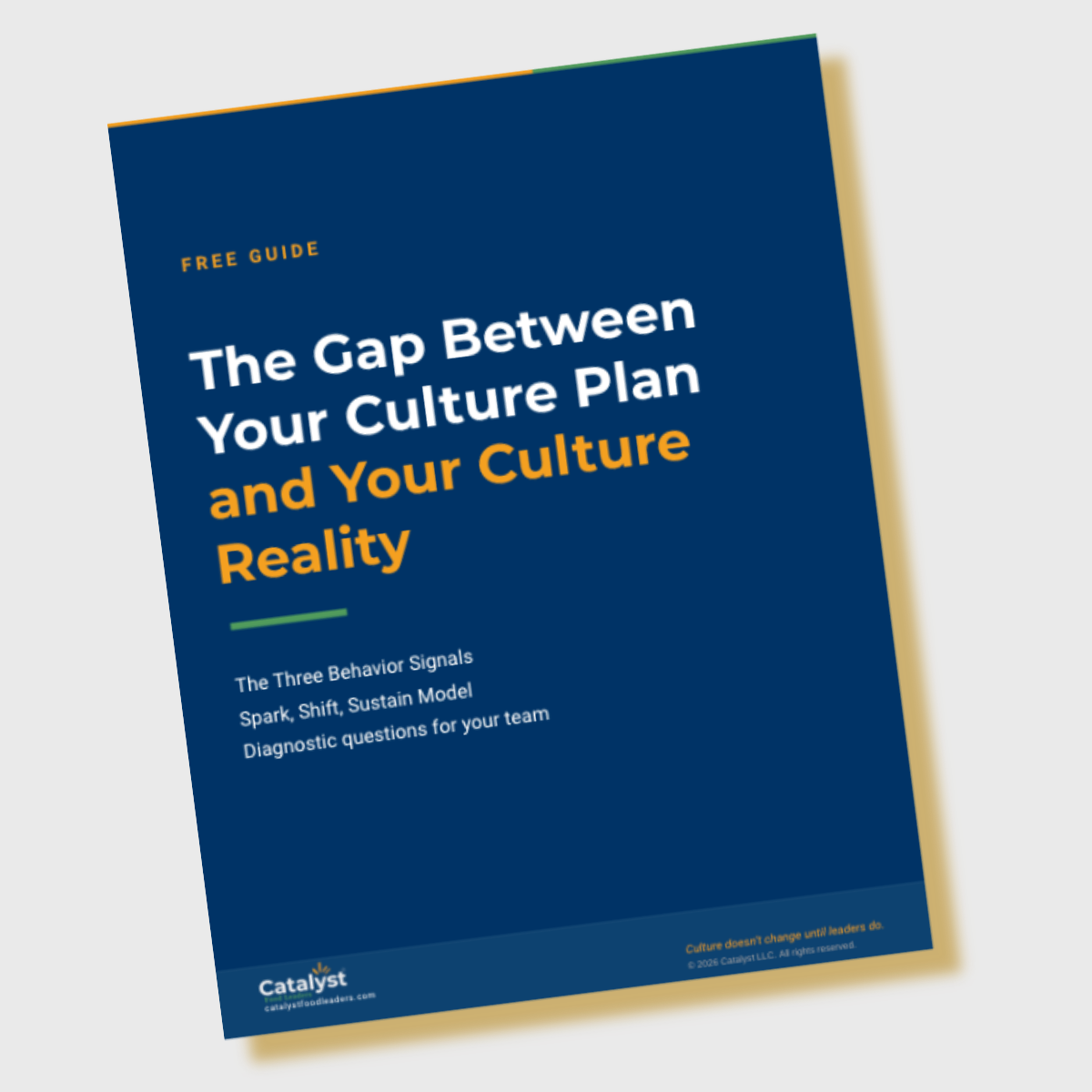
Our resource hub includes practical tools and downloads for every stage of a leadership career, from self-assessments to culture gap guides to team development frameworks. If you are looking for an entry point before committing to a program, it is a strong place to start.
We also offer interactive workshops for teams that need a focused session to create movement. These are not passive lectures. They are hands-on, honest, and designed to address the specific dynamics limiting your team right now.
Overcoming the Challenges That Keep Coming Back
Low engagement scores almost always tell you something is wrong. They rarely tell you what. Leadership Development Coaching helps leaders get underneath those numbers and address the behaviors that are actually driving them.
Turnover is one of the most expensive problems in food manufacturing, and one of the most preventable. When people feel led well, they stay. When they feel unclear about what they own, unsupported through the hard moments, or invisible in the culture, the best ones leave first. Every departure makes the dependency problem worse.
Cross-functional gaps create a different kind of cost. Operations, food safety, and HR might all know their lanes. But when accountability falls in the space between them, nothing gets owned. Leadership Coaching for Food Industry teams builds the communication and shared accountability that closes those gaps before they become audit findings or turnover triggers. You can read more about how this dynamic plays out in our piece on burned out or just blurry: how unclear workloads kill teams.
Frequently Asked Questions About Food Industry Leadership
What makes food industry leadership training different from generic training?
Generic training was not built for a 5 a.m. production push, a third-party audit, or the cross-functional complexity of a food manufacturing environment. Catalyst programs are designed specifically for food professionals by people who have worked these roles from the inside. The material lands differently because the context is not simulated. It is real.
How do you measure the success of a leadership program?
Not by post-training surveys. True success shows up in sustained behavior change on the floor. In how leaders handle conflict. In whether accountability transfers across departments or stays concentrated in a few people. In how well the culture holds during stressful periods. The goal is an organization that operates well long after the formal engagement ends.
Who should participate in leadership coaching?
Anyone who guides others. First-time frontline supervisors developing their foundational skills. Mid-level managers learning to influence across departments without relying on formal authority. Senior leaders shaping culture at scale. A unified approach across levels ensures everyone is speaking the same language and building toward the same cultural goals.
Can leadership training actually improve food safety?
Yes, and this connection is more direct than most organizations realize. When leaders communicate clearly, build trust, and hold accountability consistently, teams follow safety protocols because they understand why it matters, not just because someone is watching. Food safety culture lives in leadership behavior. GFSI schemes like SQF, BRC, FSSC 22000, BRCGS, or IFS will now audit exactly that. You can explore this connection further in our post on the human ingredient: why leadership, not AI, is the future of food safety culture.
How long does it take to see a shift in company culture?
Individual leaders often apply new behaviors immediately. Shifting an entire culture is a longer arc. Most organizations begin to see meaningful changes in communication and accountability within a few months of sustained engagement. The deeper cultural roots take a year or more, but they are built to last. We partner through that transition to make sure the new behaviors hold.
Your Team Is Ready for This
The gap between where your organization is and where it is capable of going is not a knowledge problem. Your people know the procedures. The gap is behavioral. It lives in how leaders respond when something goes wrong under pressure, in whether accountability transfers across functions, in whether new leaders get absorbed into the existing culture or quietly start to reshape it.
Closing that gap is exactly what Catalyst was built to do.
If you are thinking about what deliberate career growth looks like for the people on your team, our post on going from manager to director: intentional moves for career elevation is a strong starting point.
When you are ready to look honestly at what your leadership culture is producing, we are here for that conversation. Book a free Culture Gap Conversation at catalystfoodleaders.com/contact and let us look at where your organization stands today and what a realistic path forward looks like.